By Tim Rohr
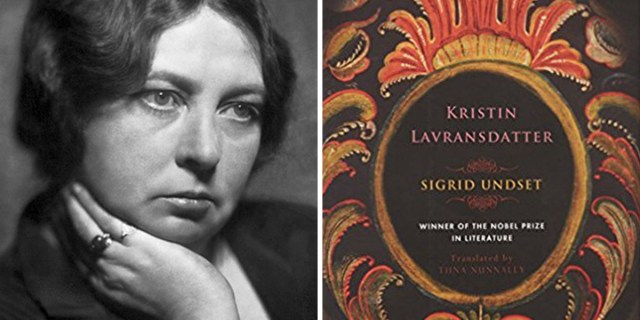
I've written about the Norwegian author, Sigrid Undset, before, and most recently a couple days ago in a post about converts to Catholicism - which Undset is.
I'm not a big literature guy, so until about ten years ago I had never heard of Undset.
I learned of Sigrid Undset from a friend. I'll call her Mary. Mary was an atheist, really atheist.
Nevertheless, Mary was a lover of novels and somehow she came across Sigrid Undset's trilogy, Kristen Lavransdatter.
Kristen is steeped in the Catholicism of 14th century Norway. And since I was the "most Catholic guy" Mary knew, she told me about Kristen - enthusiastically!
I don't suppose I would have read Kristen except for the fact that I was curious as to why Mary, an atheist, was so enthusiastic about a novel that was so "Catholic." So I bought the book, books actually, it's a trilogy.
I won't say I couldn't "put it down." I put it down many times simply because Undset's prose was so extraordinarily deep and consuming that I had to digest it in little bites. I'll just say that I didn't want the story to end...and I'm not a reader or fan of fiction.
Though Undset would later convert to Catholicism, she was still an atheist at the time she penned Kristen and there was nothing in Kristen that was intentionally Catholic. Catholicism was simply the 14th century, Norwegian, historical milieu in which Kristen is situated.
If anything, Undset, at the time, had no care for religion, but was deep into history, as she wanted her historical fiction to be absolutely authentic - which it certainly is.
The eminent Anglican convert to Catholicism, Cardinal John Henry Newman, famously said, “To be deep in history is to cease to be a Protestant.” Or in other words, "to be deep in history is to be Catholic."
Undset, despite her hardcore, early twentieth century, cold atheism - in becoming "deep in history" to research her writings - researched and wrote herself into the Catholic Church, and along the way picked up the 1928 Nobel Prize for Literature.
Oh, and yes, Mary became Catholic too.
It was an amazing thing to watch: a cold, analytical atheist...then, a sudden "reversal," and a desire, nay, a hunger, to become Catholic.
What was more amazing - at least to me - was Mary's persistence to become Catholic in the face of what Mary told me about her Catholic "classes," which were conducted by well-meaning lay people who knew much less about the Catholic Faith than Mary had already learned on her own.
Amazingly Mary sat quietly through these watered-down, spiritless, and even error-filled "classes" (her description), and simply "put up" with it because it was a door she had to get through to become Catholic - a hunger which could not be quenched short of Baptism, Holy Communion, and Confirmation.
Note: We "cradle-Catholics have no idea."
Mary had no reason to become Catholic other than she knew Catholicism was true and she wanted to be true, just like Sigrid Undset...and so many others who have quietly converted.
Mary was not seeking to please anyone but Jesus.
So often converts come into the Church to please a spouse, or in-laws, or to be otherwise socially accepted in a predominantly Catholic society - like Guam. But not Mary.
And her conversion may be even more exceptional than Sigrid's.
At least in Undset's time (early 20th century), there still existed a solid Roman Catholic Church with its unshakeable doctrine, popes willing to die for that doctrine, and the wondrous and immutable Mass of the Ages.
Not so in Mary's time. And I need not carry on about Mass with bongos, a pope who insists on "making a mess," and doctrine that is as hard to find as is the tabernacle in many churches.
But, in her heart, Mary knew what was true, and she could care less about who was pope, what Fr. Feelgood was preaching about this Sunday, or bongo Masses. In fact, Mary even went so far as to attempt to teach her functionally atheist adult children about the evils of contraception - openly admitting to them that she had been wrong to contracept.
But back to Sigrid Undset.
My great regret is I didn't discover Sigrid Undset earlier so I could share her with my six daughters - though I did give my youngest, a young teen, a copy of Kristen, last I saw her. I pray she reads it.
Here's a great article (which I both link and copy in full below):
5 Reasons your daughter should be reading Sigrid Undset
In 1920, a Norwegian woman named Sigrid Undset published a historical novel called Kristin Lavransdatter. A few years later, Undset would be received into the Catholic Church. And a few years after that, she would win the Nobel Prize for literature and donate all the prize money to charity. One of the charities she supported served mentally disabled children, and her passion for this arose from being a mother of two children of her own who struggled with disabilities, one of whom she had adopted.
Undset is a remarkable woman and deserves to be a feminist hero simply for her life-story alone.
But Kristin Lavransdatter reflects the personality of its author. Written at a time when women in novels were often either docile and lacking personality or sinful seductresses heading to a bad end, Kristin is neither. Set in medieval Scandinavia, the trilogy follows Kristin as she grows up, makes mistakes, sins, and fights her way to redemption and happiness. Her life is real, her experiences difficult, the choices she makes disastrous, but she also matures as a woman, finds forgiveness, and follows an interior journey of spiritual development.
The novel is long, but the fascinating descriptions of medieval life and the content of the story make it worth it. This book is probably best suited for teenage girls and older because of the challenging subject matter, but I can think of no better book for my own daughters to read during this period of their life as they too are finding their place in the world.
Here are 5 reasons I want my daughters to read Undset’s Kristin Lavransdatter:
Kristin makes mistakes with boys
I mean, she makes huge mistakes. As she approaches marriagable age, a local man named Simon shows his interest. He is kind, good, and a steady provider, so of course Kristin impulsively rejects him. Instead she attaches herself to an errant knight with no money and no morals, follows him out of town, and conceives a child with him.
When it comes to dating and especially teenage romances, we’ve probably all made mistakes — that’s simply part of growing up. Kristin shows us the natural result of those mistakes when they go too far and how careful we must be with the gift of our hearts. Hopefully her story will help my daughters develop prudence to avoid sharing a similar heartache.
Kristin quarrels with her father
Daddys and daughters have arguments; it’s a fact of life. Those arguments don’t have to separate us forever, though. Kristin has a major quarrel with her father when she spurns Simon, the husband her father has chosen for her, and instead runs off with her handsome playboy. Bookish Girl writes, “Kristin defies her father, her community, and her god to bind herself to Erland, boldly assuming all the dangers and adventures of his turbulent life. As her admirer Simon Andresson says: ‘You trod all underfoot and braved all that you might come together.’” In the end, Kristin and her father reconcile, even though he never approved of her actions.
Kristin holds grudges
Kristin has trouble with forgiveness, and in the book this isn’t depicted as a healthy personality trait. For instance, after quarreling with Erland, now her husband, they separate and refuse to grant each other forgiveness. Finally, it is only as Erland is dying in her arms that they come back together. It is so easy to cut people out of our lives the instant we think they’ve wronged us that sometimes the decision to do so is considered a virtue. Undset doesn’t fall into that trap, and examines honestly the effects of unforgiveness in our lives.
Kristin is a realistic mother
Much of the novel deals with the joys and challenges of motherhood. It doesn’t ignore realities like breastfeeding and nausea and it also doesn’t leave out the enchantment of cuddling with an infant for naptime.
Undset also masterfully describes the spiritual effects of motherhood. Kristin contemplates her first child who was born while she was still unmarried, “Conceived in sin. Carried under her hard, evil heart. Pulled out of her sin-tainted body, so pure, so healthy, so inexpressibly lovely and fresh and innocent. This undeserved beneficence breaks her heart in two; crushed with remorse, she lays there with tears welling up out of her soul like blood from a mortal wound.”
The innocence and purity of the child is a gift to the mother, who is careworn and feels like a failure. None of us is the perfect parent, but children can become our guide to heaven.
Kristin is religious
In pop culture, religion tends to be relegated to a few, ethereal saints or hypocritical puritans. Kristin’s faith is neither. It’s earthy and authentic. In other words, it’s an actual, honest depiction of religion as we all experience it.
Ruth Graham writes at Slate, “As flawed as Kristin is — she is proud, lustful, brooding, and fails to live up to her own moral standards — she is a devout believer… one of the most remarkable things about the trilogy is that it’s a rare literary depiction of religious people that is both empathetic and unsentimental.”
We all want our children to have a strong spiritual life, and the first step is acknowledging that we are all very much flawed, but in spite of that we are all very much loved.

