Showing posts with label Lives of the Saints. Show all posts

Saturday, November 4, 2017

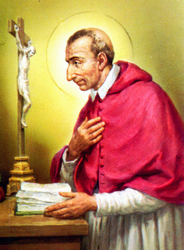
NOVEMBER 4. FEAST OF ST. CHARLES BORROMEO

From a sermon given during the last synod he attended, by Saint Charles, bishop

Practice what you preach

I admit that we are all weak, but if we want help, the Lord God has given us the means to find it easily. One priest may wish to lead a good, holy life, as he knows he should. He may wish to be chaste and to reflect heavenly virtues in the way he lives. Yet he does not resolve to use suitable means, such as penance, prayer, the avoidance of evil discussions and harmful and dangerous friendships. Another priest complains that as soon as he comes into church to pray the office or to celebrate Mass, a thousand thoughts fill his mind and distract him from God. But what was he doing in the sacristy before he came out for the office or for Mass? How did he prepare? What means did he use to collect his thoughts and to remain recollected?

Would you like me to teach you how to grow from virtue to virtue and how, if you are already recollected at prayer, you can be even more attentive next time, and so give God more pleasing worship? Listen, and I will tell you. If a tiny spark of God’s love already burns within you, do not expose it to the wind, for it may get blown out. Keep the stove tightly shut so that it will not lose its heat and grow cold. In other words, avoid distractions as well as you can. Stay quiet with God. Do not spend your time in useless chatter.

If teaching and preaching is your job, then study diligently and apply yourself to whatever is necessary for doing the job well. Be sure that you first preach by the way you live. If you do not, people will notice that you say one thing, but live otherwise, and your words will bring only cynical laughter and a derisive shake of the head.

Are you in charge of a parish? If so, do not neglect the parish of your own soul, do not give yourself to others so completely that you have nothing left for yourself. You have to be mindful of your people without becoming forgetful of yourself.

My brothers, you must realize that for us churchmen nothing is more necessary than meditation. We must meditate before, during and after everything we do. The prophet says: I will pray, and then I will understand. When you administer the sacraments, meditate on what you are doing. When you celebrate Mass, reflect on the sacrifice you are offering. When you pray the office, think about the words you are saying and the Lord to whom you are speaking. When you take care of your people, meditate on the Lord’s blood that has washed them clean. In this way, all that you do becomes a work of love.

This is the way we can easily overcome the countless difficulties we have to face day after day, which, after all, are part of our work: in meditation we find the strength to bring Christ to birth in ourselves and in other men.

Monday, June 19, 2017

THE SAINT OF THE DAY...AND FOR OUR DAY

A monk who stood up to other monks. A monk who obviously cared more about TRUTH over "peace."


For those in need of a little history, St. Peter Damian penned the infamous Book of Gomorrah a few years after Romuald's death:

https://en.wikipedia.org/wiki/Liber_Gomorrhianus
In this, Petrus Damiani made an attack on homosexual practices, mutual masturbation, copulation between the thighs, anal copulation and solitary masturbation,[1] as subversive disruptions against the moral order occasioned by the madness associated with an excess of lust. He was especially indignant about priests having sexual relationships with adolescent boys. He singles out superiors who, due to excessive and misplaced piety, have been lax in their duty to uphold church discipline. He opposes the ordination of those who engage in homosexual sex and wants those already ordained dismissed from Holy Orders. Those who misuse the sacraments to defile boys are treated with particular contempt.

Order the book here:

Thursday, March 12, 2015

TODAY'S SAINT: ST. LUIGI ORIONE, PRIEST

Too often today Catholics are led to believe that Pope Francis is the first pope to ever care about the poor or that the church was somehow aloof and deaf to the cries of the poor before Vatican II. That's absolutely ridiculous but it's nice to be able to show just how ridiculous that idea is in the concrete reality of today's saint. Among his many good works, St. Luigi Orione set up special homes for the care of the suffering and abandoned. His example is a real lesson to our post-Vatican II modern American church which seems to look more to legislation instead of love to deal with these realities. 

Tuesday, January 13, 2015

SAINT HILARY OF POITIERS

Today, January 13, is the feast day of SAINT HILARY OF POITIERS Bishop and Doctor of the Church (c. 315-c. 367) He is a saint especially relevant to our present struggle. Sadly, too many people despair about the divisions in our local church. But divisions have always existed and error has always had to be fought against. During the period of the Arian heresy, there were more bishops who were Arian than Catholic, though they considered themselves Catholic. But the true Church has always persevered because of great saints like Saint Hilary of Poitiers.

From Butler's Lives of the Saints.

13 January SAINT HILARY OF POITIERS Bishop and Doctor of the Church (c. 315-c. 367)         

St. Hilary was a native of Poitiers in Aquitaine. Born and educated a pagan, it was not till near middle age that he embraced Christianity, moved thereto mainly by the idea of God presented to him in the Holy Scriptures. He soon converted his wife and daughter, and separated himself rigidly from all un-Catholic company.         


Thursday, December 11, 2014

OUR SAINT FOR TODAY: POPE DAMASUS

It is important for us to know in our present struggle that there have been impostors in our church since the beginning, who, in the end, were ultimately ousted by Holy Popes.

11 December SAINT DAMASUS I Pope(† 384)         

St. Damasus was born at Rome at the beginning of the fourth century. He was archdeacon of the Roman Church in 355, when Pope Liberius was banished to Berda, and followed him into exile, but afterward returned to Rome. 

On the death of Liberius our Saint was chosen to succeed him. Ursinus, a competitor for the high office, incited a revolt, but the holy Pope took only such action as was becoming to the common father of the faithful.         

Having freed the Church of this new schism, he turned his attention to the extirpation of Arianism in the West and of Apollinarianism in the East, and for this purpose he convened several councils. 

He rebuilt the church of St. Laurence, which to this day is known as St. Laurence in Damaso; he made many valuable presents to this church, and settled upon it houses and lands in its vicinity. 

He likewise drained all the springs of the Vatican, which ran over the bodies that were buried there, and decorated the sepulchres of a great number of martyrs in the cemeteries, and adorned them with epitaphs in verse.         

Having sat eighteen years and two months, he died on the 10th of December, in 384, being near fourscore years of age.

Saturday, December 6, 2014

HAPPY ST. NICHOLAS DAY


A short note to thank all who have supported the blog financially and spiritually. While we use some of the money to pay for internet related business and other things related to the cause of this blog, Christmas will also be a little happier for the 11 Rohr children.

Friday, October 24, 2014

MY RESPONSE IN THE PDN TO MR. MILLS

In Gofigan case, wrong cleric removed


Print out. Make copies. Share. Educate others.

*****

By coincidence (?), today is the feast of St. Antony Mary Claret (1807-1870). Guam could use someone like him just now.


He was born at Sallent in Catalonia. After becoming a priest he spent several years preaching to the people throughout Catalonia and also in the Canary Islands.

Returning to Spain, he established a missionary order, and founded a great religious library and publishing house in Barcelona which published millions of cheap copies of ancient and modern Catholic works.

In 1851 the Pope appointed him Bishop of Santiago de Cuba. The diocese was in a terrible state and everything needed reform and renewal.

He reorganised the seminary, enforced clerical discipline, and regularised thousands of marriages. He built a hospital and many schools. This was not done without opposition and he was the subject of fifteen assassination attempts.

Recalled to Spain in 1857 by Queen Isabella II to act as her confessor, he did further great work for the Church. His health began to fail, and he died at the Cistercian abbey at Fontfroide.

Learn more about this saint at The Life of Saint Antony Mary Claret.

Monday, October 6, 2014

TODAY IS THE FEAST OF ST. BRUNO, 1033-1101

He was born at Cologne and educated partly at Reims. He was head of the episcopal school there for almost 20 years. In 1075 he was appointed chancellor of the church of Reims and had to devote himself to the administration of the diocese. The bishop at that time, Manasses de Gournai, was impious, corrupt, and violent. Through the intervention of Bruno and others, the Council of Autun suspended Manasses, who retaliated by demolishing the houses of their accusers and confiscating their goods. In 1080 a final decision of the Pope, together with a popular uprising, deposed Manasses.

Here is the account as it appears in the Catholic Encyclopedia:

In 1075 St. Bruno was appointed chancellor of the church ofReims, and had then to give himself especially to the administration of the diocese. Meanwhile the pious Bishop Gervais, friend of St. Bruno, had been succeeded by Manasses de Gournai, who quickly became odious for his impiety and violence. The chancellor and two other canons were commissioned to bear to the papal legateHugh of Die, the complaints of the indignant clergy, and at the Council of Autun, 1077, they obtained the suspension of the unworthy prelate. The latter's reply was to raze the houses of his accusers, confiscate their goods, sell their benefices, and appeal to the popeBruno then absented himself from Reims for a while, and went probably to Rome to defend the justice of his cause. It was only in 1080 that a definite sentenceconfirmed by a rising of the people, compelled Manasses to withdraw and take refuge with the Emperor Henry IV

Pretty amazing to see that the process and problems haven't changed much in the 900 plus years since this account.

Monday, June 23, 2014

TALE OF THE TWO TOM'S

By coincidence (?) I was in the midst of reading about a saint named Fr. Tom (one of today's saints) when I received a message about another Fr. Tom. The first Fr. Tom, the saint, is Fr. Thomas Garnet who was put to death under Queen Elizabeth I. The second Fr. Tom (a different kind of saint) is our own Fr. Thomas McGrath who is thankfully still with us and, we hope, will meet a gentler end. Also, by coincidence (?) both Fr. Tom's are members of the Society of Jesus,  the Jesuits. 

Before I share what I want to say about Fr. Tom McGrath, who recently celebrated his 50th anniversary as a priest, let us learn a bit about Fr. Thomas Garnet. Copied at the end of this post is the full entry about his life as found in Butler's Lives of the Saints. But immediately below is the part about his execution:

Friday, June 6, 2014

THANK YOU FOR THE PERSECUTIONS

"Persecution". It's a word the Kiko's use to counter any question or challenge to their ways. Like so much of what is "Kiko", it is stolen from true Christianity and made to serve a new master. 

I first heard it used by a Kiko shortly after Archbishop Apuron publicly challenged Cardinal Arinze on KOLG in 2006. The whole island was disturbed by what they had heard. And I was further personally disturbed by the following attempt to cover it up - something I will relate in detail one day soon. 

I had asked a friend who was in the Neo what she thought about the Archbishop's open refusal to comply with the directive from Rome. Her answer: "Thank you for the persecutions."