Saturday, January 31, 2026

THE NCW: HOW THEY OPERATE - FROM AN INSIDER

 I Was in the Neocatechumenal Way for 15 Years: Here is How They Operate

Posted by Abby Clint on Substak


I would like to offer a critical examination of the Neocatechumenal Way, an organization that, beneath its promises of parish renewal, often functions as a shadow hierarchy that undermines the parish community. I was a member of the Way for over fifteen years and progressed through the steps until I completed the step of Initiation to Prayer. Having sat through decades of catechesis and liturgies, I have seen how the movement systematically fractures the local parish, creating a contingent of believers who rarely engage with regular churchgoers or their own parish priest. While I am also very critical of the group’s theological deviations, the reality is that heresy is only the tip of the iceberg when it comes to what this group teaches and how it operates.

The power dynamic within the Way is centered on the absolute authority of lay catechists, who often act as spiritual overlords over the personal lives of their underlings. During the First and Second Scrutinies, members are subjected to invasive public questioning where the boundaries of privacy are systematically dismantled. I witnessed a culture where members felt forced to perform a specific brand of suffering to satisfy their leaders; for example, it became a survival tactic to label one's spouse or parents as their "cross" simply to avoid further interrogation. When life-altering crises like terminal cancer were presented, the rigid theological framework of the catechists would often short-circuit because it didn't fit their pre-packaged narrative of God giving you your cross to make you holy. This control extends into the secular lives of members, with leaders frequently intervening in decisions regarding higher education or career moves, even going so far as to pressure them not to attend Catholic colleges because they will not receive an authentic education like only the Way offers.

Perhaps most disturbing is the Way’s interference in the most intimate human relationships. I have seen the community pressure women to remain with or even marry men who were clearly unstable and abusive, under the guise that a violent or drug addicted partner is a gift from God designed to teach them how to love. This psychological trap is reinforced by a specific catechesis regarding the "True Church." Within the community, it is taught that only those in the Way are truly living the Christian Faith as formulated by the Early Church, while regular Catholics and those outside the movement are effectively like Judas. This "Judas narrative" is used as a powerful tool of retention; members are told that if they leave the community, they are consciously choosing the path of the betrayer. I have seen families torn apart in tears at the end of retreats, with a daughter being pressured to continue the itinerary even though her mother chose to walk away, all under the terrifying threat of spiritual apostasy.

To insulate the community from outside feedback, the Way employs a powerful "persecution complex" tactic. Members are told that anyone who leaves or criticizes the movement is not offering a valid critique, but is actively "persecuting" them. They are taught that this opposition is to be expected because they are the "chosen people," much like the Israelites, and that the devil himself is using critics to attack the only true Way. When someone points out their cult-like strategies they are met with the response “Even the Roman soldiers called the Early Church a cult.” This turns any legitimate concern or warning into a confirmation of their own righteousness, making it nearly impossible for members to listen to the concerns of their own families or the wider Church.

While the group funnels massive amounts of money toward international projects and its vacation villa in Israel, the local diocese is left holding the bag for any legal or moral liabilities the group creates. The business side of the movement is as unglamorous as it is dangerous, operating without the transparency expected of modern religious institutions. Who knows who manages the money or how financial matters are dealt with; they are trained to treat money with disdain and not care about how much their founder Kiko is making from his private artistic contributions. For any individual, pastor, or bishop who has encountered the Neocatechumenal Way, I urge you to think twice. Whether you are considering joining a community or allowing the movement to plant roots in your diocese, understand that you are not just inviting in a questionable form of catechesis, but a sophisticated system of institutionalized control that thrives on secrecy and the systematic fracturing of the Body of Christ.

Monday, January 26, 2026

THE NEOCATECHUMENAL WAY'S BANQUET OF RUPTURE

By Tim Rohr

Copied from Classic Catholic 

The Banquet of Rupture: The Neocatechumenal Way and the Deconstruction of the Sacrificial Mass


Growing up within the Neocatechumenal Way provides a stark, unvarnished window into the "New Theology" that has permeated the post-conciliar Church, offering a firsthand look at a radical and outright rejection of the sacrificial essence of the Mass. To the initiate of the Way, the altar is not a place of bloody sacrifice made present again in an unbloody manner, but rather a table for a communal banquet. 

This shift is not merely aesthetic; it is a profound ontological rupture. By replacing the traditional emphasis on the propitiatory nature of the Eucharist, the offering of the Son to the Father for the remission of sins, with a celebration of the "Paschal Mystery" centered almost exclusively on the Resurrection and the community's joy, the Way mirrors the broader post-Vatican II tendency to prioritize the horizontal relationship between men over the vertical relationship between man and God.

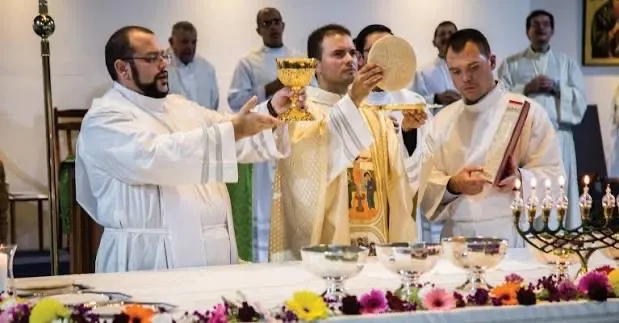
This theological pivot manifests most clearly in the physical and liturgical structure of the Neocatechumenal "Eucharist," which often takes place in a square formation around a decorated table rather than directed toward a tabernacle or a fixed altar. Such a configuration effectively deconstructs the priest’s role as the alter Christus acting in the person of Christ the High Priest, demoting him to a mere presider over a fraternal meal. 

The "errors" of the Way are, in this sense, not isolated aberrations but are the logical conclusions of a specific interpretation of the New Order of Mass. When the faithful are encouraged to receive the Host while seated and to consume it simultaneously with the priest, the hierarchical distinction between the ministerial priesthood and the common priesthood of the baptized is blurred into oblivion. This practice serves as a practical manifestation of the "New Theology" which views the Church more as a democratic assembly than a supernatural, hierarchical body.

Furthermore, the pedagogical approach of the Neocatechumenal Way, with its long-hidden catechetical directories, echoes the doctrinal ambiguity that has characterized much of the modern era. By emphasizing an existential and experiential faith over the objective, dogmatic clarity of the Scholastic tradition, the Way fosters a religious identity that is often more tied to the group’s specific "path" than to the universal deposit of faith. 

This mirrors the crisis of authority seen across the wider Church, where subjective "discernment" is frequently championed over the perennial Magisterium. In the end, reflecting on my 15 years spent within this movement reveals that the crisis of the liturgy is truly a crisis of faith; if the Mass is no longer seen as a true sacrifice, the very core of Catholicism is hollowed out, leaving behind a community-focused shell that struggles to point souls toward the transcendent reality of Calvary.

In this theological framework, the understanding of sin and propitiation undergoes a transformation that bears a striking, and often unsettling, resemblance to Lutheran thought, moving away from the Catholic doctrine of merit and toward a more fatalistic view of the human condition. 

Within the Neocatechumenal Way, sin is frequently presented not as a willful transgression that requires the medicinal grace of the sacraments and personal penance to rectify, but as an inevitable symptom of man’s "slavery to the devil." 

This perspective echoes the Lutheran concept of simul iustus et peccator, where the individual remains essentially corrupt but is "covered" by grace. By downplaying the capacity of the human will, aided by grace, to truly conquer sin and achieve sanctity, the Way risks reducing the Christian life to a perpetual cycle of acknowledging one's wretchedness without the transformative hope of actual interior justification.

This distorted view of sin naturally necessitates a rejection of the traditional Catholic understanding of propitiation. In the perennial theology of the Church, Christ’s sacrifice on the Cross is a propitiatory act: a satisfaction offered to the Father to atone for the infinite offense of sin. 

However, the "New Theology" expressed in the Way’s catechesis treats the idea of satisfying divine justice as a "legalistic" or "pagan" construct. Instead, they emphasize the Cross solely as a sign of God’s unconditional love and a victory over death, stripped of its character as a necessary sacrifice for the remission of guilt. This shift effectively removes the "transactional" necessity of the Mass; if there is no need for propitiation, the Mass ceases to be a sacrifice offered for the living and the dead and becomes merely a memorial of a historical event that validates the community’s current state.

Consequently, the role of the individual in the economy of salvation is minimized to a passive acceptance of one’s own brokenness. The Catholic call to "fill up what is lacking in the sufferings of Christ" through sacrifice and mortification is replaced by a focus on "kerygma,” a proclamation of mercy that often lacks the corresponding call to a firm purpose of amendment. 

This theological orientation mirrors the broader post-Vatican II crisis where the Sense of Sin has been lost, replaced by a psychological comfort that seeks to soothe the conscience rather than cleanse it. By framing the human person as someone who "cannot do otherwise" than sin until some mystical moment of enlightenment occurs, the Way inadvertently mirrors the Protestant denial of free will, further detaching the faithful from the traditional path of purgation, illumination, and union that has defined Catholic spirituality for two millennia.

MY NOTE

As someone (me) formed in the wake of Vatican II, it is hard to see the difference between what the NCW is doing versus what the rest of the church (or most of it) was doing since the mid-60's and even before Vatican II concluded. The emphasis on the "table" vs the altar, the community vs the sacrifice, the flowers, the guitars, the presider vs the priest...it's all there. The NCW is simply Vatican II, and its step-child Novus Ordo, writ large. Thus the modern Church has no moral authority to reign in the NCW. 

Thursday, January 22, 2026

THE NEOCATECHUMENAL WAY: A CASE STUDY

Reposted by Tim Rohr

Posted by Classic Catholic 


The Neocatechumenal Way: a case study in the “Last Supper” Theory of liturgical design


Growing up within the Neocatechumenal Way, I was immersed in a specific and rigid liturgical narrative that defined the assembly of the faithful as the only true temple of the Holy Spirit. The theology of the Way is built upon a rejection of what they term "natural religiosity," a concept they view as a pagan intrusion into the Christian faith. 

To them, the development of stone altars, sacred architecture, and fixed temples represented a departure from the primitive, itinerant church of the first centuries. They taught us that the early Christians celebrated a simple liturgy around a common table, mirroring the Last Supper, and that the use of rugs in their contemporary halls was a deliberate sign of a pilgrim people who possessed no stable place on earth. 

By stripping away the traditional accouterments of the Catholic Church, they claimed to be restoring an authentic, pre-Constantinian worship that favored spontaneous contemplation and communal experience over the "dead stones" of pagan Roman “Sacrifice”.

However, as I watched the Way expand and gain financial resources, I witnessed a profound contradiction emerge between this stated theology and their actual practice. Despite their insistence that the assembly is the only temple and that fixed sacred spaces are anti-Christian, the movement began to establish its own permanent chapels and "Domus" centers. 

These structures are not the temporary, neutral spaces their theology would suggest. Instead, they are highly specific, brutalist-modernist octagons designed in the round, featuring a massive stone table at the center and amphitheater-style seating. Every wall is meticulously decorated with icons in the unmistakable style of their founder, Kiko Argüello. 

This immediate pivot toward the construction of elaborate, permanent sacred spaces reveals an inherent insincerity in their critique of "natural religion." If they truly believed that stone altars and decorative temples were contrary to the Gospel, they would have remained in the simple, multipurpose rooms they initially championed.

This contradiction serves as more than just a critique of the movement's consistency; it provides a logical lens through which to view the history of the wider Church. The Neocatechumenal Way argues that the early Church was suppressed by the imposition of "natural religiosity" and Roman paganism once the Church gained legal status. Yet, the Way’s own behavior suggests the opposite. 

The moment they were given the permission and the money, they built temples that perfectly matched their specific theology. If the early Church had actually practiced a liturgy in the form of a communal table-fellowship in the round, we would expect to see that theology reflected in the archaeological record the moment Christians were free to build. If the "primitive" model were a circle, the first great churches of the fourth century would have been built as amphitheaters or circular dining halls.

But when we examine the historical artifacts and the earliest ruins of Christian architecture, we do not find "churches in the round." Instead, we find the basilica: a linear, directional building that points the assembly toward an altar and a sacred East. 

Therefore, this historical absence confirms that the NCW's "primitive" liturgy is a modern invention rather than a restoration. The early Christians did not build in the round because their theology was not centered on the closed circle of the community, but on the sacrifice of the altar and the expectation of the returning Christ. 

The fact that even a movement so ideologically opposed to "temples" eventually succumbed to the human necessity of building them proves that the shift toward sacred architecture in the early Church was not a pagan corruption, but a natural and authentic expression of the Faith that the Neocatechumenal Way has failed to “discover.”

See the original post for comments


FR. MIKE'S LAST HOMILY

By Tim Rohr

Later that night, he would suffer the stroke that killed him. How appropriate that his last words were "I love you."

https://www.facebook.com/reel/1540893187143238

FROM FELICITY

 Reposting from a follower in Australia:


Thanks Tim for your excellent website Junglewatch- please post this article & summary about Pope Leo 19/1/26 meeting 1000 members of Neocatechumenal Way

posted by Felicity from Australia 

Pope Leo on 19/1/26 at an audience with Kiko Arguello and 1000 Neocatechumenal way members responded  to the many complaints about the Neocatechumenal way. 
His comments show the Popes  grave concern about Kiko Arguello and Nc catechists using coercive control , inducing guilt and fear  to control others , telling them to obey Nc leaders and not respecting a persons privacy, internal forum or their conscience.

Kiko Argüello and Nc leaders send people including babies &  children to dangerous places including war zones and encourages them to die as a martyr eg China , PNG , Ukraine . Sudan , Nigeria . The pope was warning them of the risks. They are on notice now and if they disobey then the Pope has options to take the matter further 
The Neocatechumenal way often isolate themselves having separate masses and meetings each week ONLY for Nc members as if they are a parallel church. Pope Leo reminds and reprimands them as previous popes have done - Kiko was at the private papal audience with Pope Leo and 1000 Neocatechumenal members - these  criticisms and mandates by Pope Leo were directed specifically at the Neocatechumenal Way 

The Neocatechumenal way cult has done immense damage to my family for more than 20 years including spiritual abuse , emotional abuse, and severe financial abuse - but they hide the money from the local bishop and parish - no accounting for where the tithe and other enormous amounts have gone when given to the catechists who say “ renounce the goods””show money is not your God” and humiliate people at guarantors meetings and scrutinies if they don’t obey or don’t give enough money to the lay catechists. Pilgrimages continue by Neocatechumenal Way in 2026 to West Bank and Israel despite the war and “do not travel “ govt warnings. 

The pope must act decisively  to stop the damage being done by Kiko and Neocatechumenal leaders. The Neocatechumenal Way have not heeded the  warnings by previous Popes . Most activities are not approved  by the Vatican in the Statutes of the Neocatechumenal Way  
  • the tithe - unapproved , 
  • request to obey Catechists- unapproved 
  • spiritual marriage - unapproved 
  • Ketubah covenant in Israel - unapproved 
  • milk and honey ceremony - unapproved 
  • After receiving the white garment
  • - Kiko emphases “ renounce the goods” “ go on mission “ and misuses a bible quote about 
  • “Common goods “to insist you  share all your money with Nc- unapproved 

19/1/25 Pope Leo told the members of the Neocatechumenal Way that they must live their spirituality “without ever isolating yourselves from the rest of the ecclesial body” and to “go forward in joy and humility, without closing yourselves off, as builders and witnesses of communion.”  

You do a great amount of good, but its goal is to allow people to know Christ, while always respecting the life path and conscience of each individual,”  Pope Leo said. The proclamation of the Gospel, catechesis, and the various forms of pastoral activity must always be free from forms of coercion, rigidity, and moralism, so that they do not generate feelings of guilt and fear rather than interior liberation,” he said.


The pope’s words on personal freedom echoed similar remarks by Pope Francis, who, in 2014, warned the ecclesial reality against the dangers of pressuring its members and to respect their choice “to seek, outside the Way, other forms of Christian life that may help him or her to grow in their answer to the Lord’s response.”


The pope also expressed his gratitude to the many families in mission who left behind “the securities of ordinary life” and set out on mission, sometimes in dangerous areas, “with the sole desire of proclaiming the Gospel and witnessing to God’s love.”


The pope also told members of the Neocatechumenal Way that carrying out the mission to evangelize also requires interior vigilance and wise critical capacity to discern certain risks


There is so much invasion of privacy , coercion , secrecy, control by the Neocatechumenal Way. They often keep secrets from the local bishops and a Neocatechumenal priest told me that they won’t show the bishop or anyone in the parish what they do with all the money and belongings they collect from people . The “tenth” or “tithe” to lay catechists and request to “ obey lay catechists and Kiko Arguello has never been approved by the Vatican.  It’s not in the statutes. At the “spiritual marriage ceremony “ and “Ketubah “ covenant in Israel the catechists insist lifelong on a huge financial commitment and obedience to Kiko Arguello and the catechists. The communities are still being sent to Israel for pilgrimages despite the war.  


They have destroyed so many marriages and families 


——-

Pope Leo 19/1/26 meeting 1000 members of Neocatechumenal Way 


Posted by Felicity 

Tuesday, January 20, 2026

THE HOMILY AT FR. MIKE'S FUNERAL MASS

 Given by Msgr. James Benavente


or at this link


PATHETIC

By Tim Rohr


A bishop is a father to his priests and the priests are his sons. 

In fact, the bishop-priest relationship is even more a father-son relationship than the biological father-son because whereas our children can grow up and remove themselves from our authority after a certain age, a priest, and in this case a diocesan priest, makes a Promise of Obedience to his bishop-father for life or at least until a priest is released from that promise by an official act (such as excardination). 

Imagine your son dying. You show up for the funeral but don't bother to attend the burial. Instead you have lunch with friends and let others bury him.

This is what Archbishop Jimenez did. After the funeral, he enjoyed lunch at a nearby restaurant while he let others bury his son, Fr. Michael Crisostomo.

Pathetic.

One wonders what Fr. Mike did to deserve to be treated this way, both in the final months of his life and now in death.


Monday, January 19, 2026

WHERE DID HE GO?

By Tim Rohr

At the Funeral Mass for Fr. Mike Crisostomo on Saturday, January 17, the archbishop, after the gifts are brought up at the offertory, and instead of returning to the altar, exits stage left, disappears from the camera, then reappears. Where did he go?


Friday, January 16, 2026

WHY I'M CATHOLIC: A SERIES

By Tim Rohr

I have re-published my book WHY I'M CATHOLIC as a series on Substack. It's also available as an ebook here and here.


Thursday, January 15, 2026

THIS IS GETTING WEIRDER AND WEIRDER

By Tim Rohr


This is getting weirder and weirder. Following is a copy of a post on the Archdiocese of Agana Facebook page (highlight added):


Planned drive past parishes with Fr. Mike's casket adjusted, shortened

---

Regarding the driving of Father Mike Crisostomo's casket past island parishes on Thursday, Jan. 15, the family has advised the Archdiocese of Agaña that in consideration for the body of dear Palé, the schedule will not permit driving past all parishes.

The family has instead coordinated with Ada's Mortuary on a shortened schedule that will primarily only include parishes where Palé Mike was assigned and where he celebrated his first Mass for instance. The archdiocese is not coordinating the schedule or this part of activities honoring the beloved priest.

The family appreciates everyone's love for Palé Mike and asks for your understanding.

---

Relayed by the Archdiocese of Agaña Office of Communications

+++++

Again, as we have been seeing and hearing since the news of Fr. Mike's demise, the "archdiocese" continues to go strangely out of "its" way to distance "itself" from Fr. Mike's death. Even if the family is coordinating the so-called drive-by, why is it necessary for the "archdiocese" to emphasize that "it" is not.

It's not necessary, unless of course, "they" have a reason. And what would be that reason? 

By the way, all of the above words in "quotes" are in quotes because there is no such person as the "Archdiocese of Agana." There is only the Archbishop of Agana, and for some reason he refuses to put his name on the most serious of announcements (most recently those announcements related to Fr. Luis Camacho and now, Fr. Mike). 

How hard would it have been to have worded the above announcement: "...the family has advised Archbishop Jimenez..." And how much more personal and compassionate would it have been to end this announcement with the archbishop's signature under the final words of this announcement: "The family appreciates everyone's love for Palé Mike and asks for your understanding.

Instead we get an impersonal: "Relayed by the Archdiocese of Agaña Office of Communications."

Another very strange thing is the "for instance" in the following sentence:

"...a shortened schedule that will primarily only include parishes where Palé Mike was assigned and where he celebrated his first Mass for instance."

Huh...? For instance? Really?

The archbishop doth protest too much, methinks. 


Monday, January 12, 2026

PELL V APURON - A STUDY OF TWO BISHOPS WHO RAN

By Tim Rohr


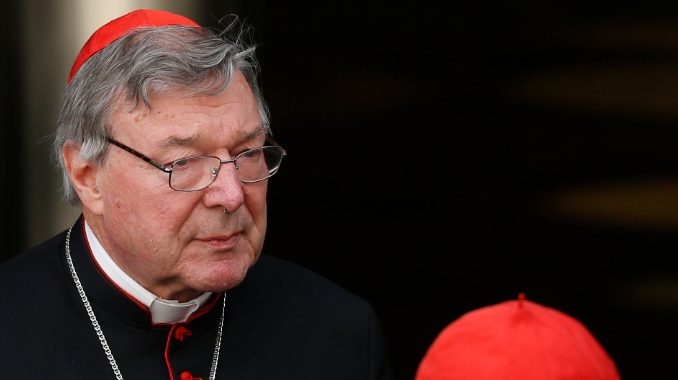
The CATHOLIC WORLD REPORT has published an important reflection on the life of the late Cardinal George Pell on the second anniversary of his death (Jan. 10, 2023). It's an important read for us in this archdiocese (Guam) because it allows a very stark and timely comparison between two bishops who were accused of child sex abuse: Pell and Apuron.

Both Pell and Apuron were accused at approximately the same time (2015-2017). At the time I pointed out on this blog that while Apuron RAN AWAY from his diocese to Rome seeking protection, Pell, on the other hand "ran" back to his diocese (in Australia) and away from Rome (where he was the Secretariat for the Economy) to clear his name. 

Let's review: Apuron ran away. Pell ran to. 

Pell was convicted and spent 404 days in prison while he appealed his case. Ultimately, the High Court of Australia overturned his conviction. Pell, while the victim of anti-Catholicism in Australia, was more so the victim of his enemies in the Vatican. 

Let's remember who ran, and where they ran to. 

The late great George Pell and his enemies

Saturday, January 10, 2026

THAT'S WHAT WE WANT TO KNOW ABOUT

By Tim Rohr


On Wednesday, Jan. 7 (2026), a Clergy Day of Recollection for priests and deacons of the Archdiocese of Agana was held at the Dominican Child Development Center in Ordot. According to the announcement, the focus was on "the very important subjects of child abuse and bankruptcy." The announcement is copied from the AOA Facebook page:

Clergy Day of Recollection focuses on child abuse and bankruptcy 

---

The very first Guam Clergy Day of Recollection for priests and deacons of the Archdiocese of Agana in the New Year focused on the very important subjects of child abuse and bankruptcy Wednesday, Jan. 7 in Ordot. The Dominican Sisters and the Dominican Child Development Center (DCDC) hosted the clergy at their site in Ordot.

With Father Fran Hezel, SJ as Day of Recollection facilitator, Archbishop Ryan P. Jimenez and the clergy welcomed three very seasoned Guam professionals in respective social work and legal professions to give presentations and lead important discussions in those areas. 

On June 20, 2023, the United States District Court of Guam announced the official closing of the Archdiocese of Agana’s Chapter 11 Reorganization (bankruptcy) case related to clergy sexual abuse. The archdiocese reached a formal agreement of reparation and compensation with the victim-survivors of clergy sexual abuse who were severely harmed by former members of our archdiocese. Nearly three hundred lawsuits related to clergy sexual abuse were filed against the archdiocese. The effort to bring healing and compensation continues for our Church on Guam.

Honorable John C. Terlaje, Superior Court of Guam Judge; Dr. Juan Rapadas, longtime licensed clinical psychologist; and Attorney Rodney J. Jacobs, longtime lawyer and partner in the law firm of Calvo, Jacob and Pangelinan, LLP engaged in conversations with the clergy during this week's Day of Recollection.

All devoted Catholic men who are very active in the Church and and seasoned professionals in their respective fields, the speakers spoke respectfully but with frankness and honesty as they shared their knowledge, perspectives and input on child sexual abuse and the archdiocese's bankruptcy.

-----

It's good that they had this "day," and that they had the privilege of hearing from these experts; and it would be better still if we, the people who are paying the bills, could get a detailed briefing on what was said, if not a full recording.

The bankruptcy resulting from the clergy sex abuse in this diocese, which occurred at an incomprehensible scale (per capita, the worst in the whole world*), is not just clergy business, it's all of our business, and we want to know what our church leaders are doing about it other than handing us the bill. 

And by "doing about it," I don't mean the things that the court ordered them to do, I mean what are they doing about the real roots of this horror and what are they doing to make sure it never happens again. 

And it's not just about child protection. The rape and molestation of hundreds of minors was only the symptom of a much greater evil which had been eating out the heart of this church for decades. 

That's what we want to know about. 

*Before Guam's clergy sex abuse scandal was exposed, Boston's was considered the worst. It was so bad that an Academy Award winning movie (Spotlight) was made about it But then there was the Archdiocese of Agana. Per capita, Guam's clergy sex abuse scandal is FOURTEEN TIMES WORSE than Boston's. FOURTEEN TIMES!

Monday, January 5, 2026

WHAT HAPPENED?

By Tim Rohr


At 23:00 in this video, Archbishop Jimenez begins his homily. After a few minutes, he begins to describe what happened to Fr. Mike.  The Mass took place on January 2, 2026, the day Fr. Mike died. 

Archbishop Jimenez describes Fr. Mike's arrival at the clergy Christmas party "last Tuesday,"which would have been December 30, 2025. The party was at the social hall in Maina. Jimenez says that Fr. Mike left the party early and then sent him a text saying that he wasn't feeling well. 

The next day, December 31, 2025, Jimenez published the News Release advising that Fr. Mike had been hospitalized that morning. 

This is relevant given that a certain "Anonymous" appears to be adamant in inferring that Fr. Mike, after being assigned to St. Joseph in Inarajan, continued to reside at St. Anthony's, and thus experienced no particular hardship in accessing medical care:


Pale' Mike was still living at the St. Anthony rectory.

"Antonio" attempted to clarify:

This was only the case for the first few weeks after the reshuffling of priests, as his soon-to-be living space in Inarajan was still being prepared. Later on, yes, he would occasionally stop by St. Anthony Church and even stay for brief periods there whenever he was asked to either cover masses or undergo grueling dialysis treatment.

However, Anonymous insisted:

He lived at St Anthony rectory, which can house 8 priests. He was stricken in his bedroom there. Fact.

Anonymous appears to be a member of the clergy who had no "love" for Fr. Mike, or at least someone close to a member of the clergy who is vested in running interference for the reason Fr. Mike was assigned to a parish the furthest away from the critical medical care he needed.

From how Archbishop Jimenez describes it, it appears that Fr. Mike, upon leaving the Christmas party on December 30, knew he wouldn't make it to Inarajan and decided to stay the night at St. Anthony, which is why he "was stricken in his bedroom there," as Anonymous reports.


Friday, January 2, 2026

DAMAGE CONTROL?

By Tim Rohr

“…we ask everyone to please refrain from circulating rumors and unofficial, unfounded information.” - Archbishop Ryan Jimenez


PDF

Strange words from Archbishop Jimenez tacked on to the announcement regarding Fr. Mike Crisostomo's hospitalization a couple days ago.

And now, now that Fr. Mike is dead, those words are stranger still.

What "rumors and unofficial, unfounded information" could have been "circulating," and apparently in such a heightened way that the archbishop felt moved to warn everyone to stop it? 

Fr. Mike had been ill for a very long time. He had been visibly wasting away before all of us. He was, according to what he told me personally two years ago, receiving dialysis treatment 3 days a week for 3.5 hours each day.  I believe that as his disease got worse, he required even more frequent dialysis. He also was having trouble with his fistula - the access point on his arm for his dialysis. 

Strokes are not uncommon for people who suffer with diabetes, and it came as no surprise when I heard that Fr. Mike had one. But the archbishop's words WERE a surprise: "...please refrain from circulating rumors and unofficial, unfounded information." It sounds like the archbishop is afraid of something. Damage control?

Now, compare Fr. Mike's death to the death of another priest which in fact did very much warrant the circulation of rumors and unofficial information: the death of Fr. Fr Antonino Caminiti almost exactly one year ago (Dec. 14, 2024). 

The reason Fr. "Nino's" death warranted rumors isn't hard to guess at: he had been accused of sexual misconduct with a parishioner, he had been removed from the parish by Archbishop Jimenez, and he died while in the "custody" of the same archbishop.  

YET! There was NOTHING from the archbishop about the sudden and mysterious death of Fr. Antonio Caminiti other than the usual announcements about services and burial - not even a mention about the cause of death.

Additionally, pursuant to the archbishop's letter of Nov. 12, 2024, Fr. Nino was under investigation: “...the preliminary investigation was conducted and the allegation is now under further investigation as recommended by the Independent Review Board."

Has anyone heard a peep about this investigation in what is now more than one year? Nothing, as far as I know. Just because the accused is dead doesn't mean the investigation should die too. But apparently it did. 

If in fact, Fr. Nino engaged in sexual misconduct with a parishioner, this should be known. And if he didn't, then his name should be cleared. 

In the exposition of the horrible scandal this diocese has had to suffer through for ten years now, there were several dead priests who were "on trial." Just because they were dead was no cause for sudden silence about the allegations against them - as it appears to be in the Caminiti case. 

But NOTHING. (But then again, Caminiti was a Neo.)

Meanwhile, Fr. Mike, who, as already mentioned, was very visibly ill for the last several years, has a stroke and the archbishop jumps out to do what can only be characterized as DAMAGE CONTROL.

Why? 


P.S. Note that the NEWS RELEASE is not signed by anyone and only says "sent by Tony Diaz." That's exceptionally bad form. This is what the goons who ran the asylum for Apuron did: just sent out all kinds of stuff on archdiocesan letterhead but from no one. We're not going to let that go. If it's on the letterhead then it's from the archbishop. Period.