I Was in the Neocatechumenal Way for 15 Years: Here is How They Operate
Posted by Abby Clint on Substak
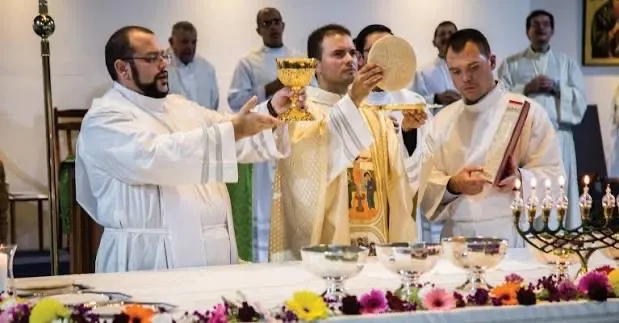
I would like to offer a critical examination of the Neocatechumenal Way, an organization that, beneath its promises of parish renewal, often functions as a shadow hierarchy that undermines the parish community. I was a member of the Way for over fifteen years and progressed through the steps until I completed the step of Initiation to Prayer. Having sat through decades of catechesis and liturgies, I have seen how the movement systematically fractures the local parish, creating a contingent of believers who rarely engage with regular churchgoers or their own parish priest. While I am also very critical of the group’s theological deviations, the reality is that heresy is only the tip of the iceberg when it comes to what this group teaches and how it operates.
The power dynamic within the Way is centered on the absolute authority of lay catechists, who often act as spiritual overlords over the personal lives of their underlings. During the First and Second Scrutinies, members are subjected to invasive public questioning where the boundaries of privacy are systematically dismantled. I witnessed a culture where members felt forced to perform a specific brand of suffering to satisfy their leaders; for example, it became a survival tactic to label one's spouse or parents as their "cross" simply to avoid further interrogation. When life-altering crises like terminal cancer were presented, the rigid theological framework of the catechists would often short-circuit because it didn't fit their pre-packaged narrative of God giving you your cross to make you holy. This control extends into the secular lives of members, with leaders frequently intervening in decisions regarding higher education or career moves, even going so far as to pressure them not to attend Catholic colleges because they will not receive an authentic education like only the Way offers.
Perhaps most disturbing is the Way’s interference in the most intimate human relationships. I have seen the community pressure women to remain with or even marry men who were clearly unstable and abusive, under the guise that a violent or drug addicted partner is a gift from God designed to teach them how to love. This psychological trap is reinforced by a specific catechesis regarding the "True Church." Within the community, it is taught that only those in the Way are truly living the Christian Faith as formulated by the Early Church, while regular Catholics and those outside the movement are effectively like Judas. This "Judas narrative" is used as a powerful tool of retention; members are told that if they leave the community, they are consciously choosing the path of the betrayer. I have seen families torn apart in tears at the end of retreats, with a daughter being pressured to continue the itinerary even though her mother chose to walk away, all under the terrifying threat of spiritual apostasy.
To insulate the community from outside feedback, the Way employs a powerful "persecution complex" tactic. Members are told that anyone who leaves or criticizes the movement is not offering a valid critique, but is actively "persecuting" them. They are taught that this opposition is to be expected because they are the "chosen people," much like the Israelites, and that the devil himself is using critics to attack the only true Way. When someone points out their cult-like strategies they are met with the response “Even the Roman soldiers called the Early Church a cult.” This turns any legitimate concern or warning into a confirmation of their own righteousness, making it nearly impossible for members to listen to the concerns of their own families or the wider Church.
While the group funnels massive amounts of money toward international projects and its vacation villa in Israel, the local diocese is left holding the bag for any legal or moral liabilities the group creates. The business side of the movement is as unglamorous as it is dangerous, operating without the transparency expected of modern religious institutions. Who knows who manages the money or how financial matters are dealt with; they are trained to treat money with disdain and not care about how much their founder Kiko is making from his private artistic contributions. For any individual, pastor, or bishop who has encountered the Neocatechumenal Way, I urge you to think twice. Whether you are considering joining a community or allowing the movement to plant roots in your diocese, understand that you are not just inviting in a questionable form of catechesis, but a sophisticated system of institutionalized control that thrives on secrecy and the systematic fracturing of the Body of Christ.

Pope Leo knows all about the Neos! He had to sack a Spanish Neo Bishop in Peru!
ReplyDeleteThe cult seems to me to operate as a magpie! Elbowing the owners out of the nest in order to take over.
Actually, from what I know if the matter in Peru, Leo, at the time, was just another bishop and had no authority to "sack" another bishop. He did, however, have to clean up the mess left by the neo bishop. But yes, "elbowing out" is a good way to describe their MO.
DeleteIf I may ask a sincere question in good faith:
ReplyDeleteIf the Neocatechumenal Way is, as defined by their own Statutes "under the jurisdiction, direction of the diocesan bishop" and "the implementation of the Neocatechumenal Way must be coordinated with the proper function that the pastor", couldn't so many of these issues be corrected/fixed if the Bishops and Pastors exercised their responsibility?
I'm thinking particularly of the notion of "dividing the parish" and "the absolute authority of lay catechists".
I'm not saying the NCW has no culpability, but I just feel like so many of these things could be remedied for the sake of those Catholics who could otherwise benefit from an authentic program of Christian Initiation.
tl;dr: Could this organization be "redeemed" if the Bishops and Pastors did their jobs?
Redeemed? Doubtful. While Rome places The Way under the authority of the clergy, The Way should not have to be policed if it is an authentic charism. It's not, of course. It's a heresy. One may wonder how a heresy can grow right in the middle of the Church. The answer is: they all began that way. Bishops and priests are always the first heretics...beginning with Judas.
Delete@Timothy. Heresy should not be redeemed. It should be destroyed and eliminated and hope, the initiators of the heresy repent and convert. and the faithful who are misled by the heretic initiators should be redeemed.
DeleteAgreed. Maybe it will happen. Much depends on the current pope.
Delete