Showing posts with label Guam Supreme Court. Show all posts

Friday, October 11, 2024

GUAM'S ABORTION DISCOMBOBULATION

By Tim Rohr


The Belle's Law issue is such a discombobulated mess that I'm having a difficult time organizing my thoughts into a coherent post about what is going on given the recent denial by SCOTUS of AG Moylan's writ of certiorari.* So I'm just going to do a stream of consciousness for this one.

* A writ of certiorari orders a lower court to deliver its record in a case so that the higher court may review it.

For starters, there is no reason for any of this court mess if the Legislature would just do its job. The problem is that the Legislature left Belle's Law on the books 30 years ago after the law was enjoined. If it was enjoined because it violated Roe v Wade at the time, and it did, then it should have been immediately repealed. But instead, the lazy Legislature left it there.

And today, the Legislature is just as lazy. There is no reason to leave the law on the books and it could be repealed with a one sentence bill. But it seems no one has thought to do that, so we've been spending tens, if not hundreds of thousands of dollars - by now, and an untold amount of time, batting this thing around in the courts. 

Even now, with the denial from SCOTUS, no one, not even the baby-blood-thirsty governor is saying "legislate the law off the books," instead they prefer to yell at AG Moylan and tell him to shut up and sit down - which of course, the governor and her culture-of-death crew viciously enjoy.

Another discombobulation is that the denial by SCOTUS did NOT have anything to do with Belle's Law or even abortion. It had to do with whether or not the Guam Supreme Court had the authority to issue a declaratory judgment. Moylan argued that it didn't. And I argued the same in GHOSTS THAT SLAY.

However, if you listen to the governor, Jayne, and the ACLU - and the media isn't helping much, you'd think that SCOTUS handed down a decision as momentous as Roe v Wade. And of course, the pro-aborts are purposely playing it that way given that few understand what is really going on, and our local Catholic Church - via its Vicar General -  can only say it is "saddened." 

In fact, there's nothing to be sad about, and everything to bet bucked up about. (Someone tell "the Church.") The case that matters is still very much alive and this is AG Moylan's appeal which lies before the 9th Circuit. This is an appeal of the local District Court's decision to deny Moylan's motion to dissolve the 1990 injunction on Belle's Law.

The 9th Circuit has already made one decision in an abortion related matter that was not in the pro-aborts favor. And maybe this is why Lou, Jayne, and the ACLU are so rabid about shutting Moylan down ASAP.

Meanwhile, it's no surprise how the pro-aborts are playing the SCOTUS thing. Lies and deception are their modus operandi. But even though they play us for stupid, it doesn't mean that we have to be. 

Another matter

Another matter I've been meaning to address is the Guam Supreme Court's opinion (that's all it was: an opinion - not a decision) that Belle's Law had been repealed by implication. The Post reports it here:

By the end of October 2023, the Guam Supreme Court ruled that P.L. 20-134 no longer had any effect on Guam, since it was repealed by implication through subsequent laws allowing for and regulating abortion.

I was one of two amici who argued before the Guam Supreme Court in July 2023 against the governor's position that Belle's Law had been repealed by implication or was void ab initio (here and here). 

The Court ended up opining that Belle's Law had been repealed by implication due to the presence of four laws limiting abortion that had been enacted into law since Belle's Law, but, due to the strictures of Roe, still permitted abortion: The Partial-Birth Abortion Ban (2009), Parental Consent for Minors (2011), Informed Consent for Abortion (2012), and the Abortion Reporting Law (2015).

What's so ironic is that The Esperansa Project, which included myself and a few friends, was the main driver behind all four laws. In fact, over a period of eight years, we had successfully guided eight bills limiting abortion into the Guam Code. Under Roe, attempting to ban abortion outright was futile, so we did what many other states had already done, wrote and shepherded bills which limited abortion to the fullest extent of the law under Roe. 

Yet, here we were in 2023, having our own legislation used against us to support the governor's campaign for death in the womb. 

On a personal note, I can't help but think that one of the Justices sort of knew my role in all that because he spent several pages functionally attacking me in his Concurring Opinion. Given that I was only an amicus at the hearing, and a rather poor one at that, I was surprised to see that I took up so much space in the final opinion. 

End of stream of consciousness. 

Monday, November 20, 2023

HAPPY HALLOWEEN - FROM THE GUAM SUPREME COURT - AND DAY OF THE DEAD...LAW

By Tim Rohr


This past October 31, the Guam Supreme Court issued an opinion agreeing with our pro-abort governor that "Belle's law" is of no force and it is okay to keep killing our own.

There will be more comment on this opinion to come. But for now, here is what the Guam Supreme Court opined:

JUDGEMENT

OPINION 

Also, the Guam Daily Post had an interesting title to its story on said opinion:

Adelup: Supreme Court decision holds abortion ban as 'dead law'

The Office of the Governor said the decision holds the ban as "dead law."

Thursday, March 2, 2023

OUR DESPERATELY GRASPING GOVERNOR

By Tim Rohr


In opposing Moylan, Leslie Travis, the governor's lawyer, argued that subsequent laws on abortion have resulted in the implied repeal of the 1990 ban, holding the motion to vacate moot. - Guam Daily Post, Mar. 2, 2023)

No media stories thus far have identified which "subsequent laws on abortion" "have resulted in the implied repeal of the 1990 ban." 

However, the Guam Supreme Court Order does:

The Governor is asking whether the Women’s Reproductive Health Information Act of 2012, the Partial-Birth Abortion Ban Act of 2009, and the enactment of 19 GCA §§ 4A101-102, 4A107, and 4A109 served as implied repeals of P.L. 20-134. (Links added.)

Note: 19 GCA §§ 4A101-102, 4A107, and 4A109 refer to Parental Consent for Abortion for minors. 

The governor's argument is that because these laws do not ban abortion but continue to allow it under certain circumstances then these laws "resulted in the implied repeal of the 1990 ban."

None of these three laws addressed the legality of abortion, which is why the governor relies on the word "implied." 

The Women's Reproductive Health Information Act (informed consent for abortion) and the afore-referenced sections of the law relative to Parental Consent for Abortion did not proscribe or limit abortion access but only required the distribution of information and normal medical consent. 

The Partial-Birth Abortion Ban sought only to ban a particularly heinous and gruesome abortion procedure which found its precedent in the U.S. Supreme Court case Gonzales v. Carhart, 127 S. Ct. 1610 (2007) as well as the Federal Partial-Birth Abortion Ban Act of 2003.

For the governor to hold that abortion cannot be outlawed in Guam pursuant to P.L. 20-134 because of subsequent laws would be the same as the Court in Dobbs saying "well we can't reverse Roe because the Federal Partial-Birth Abortion Ban Act of 2003, other than banning a particular procedure, still allowed for abortion generally."

The analogy is absurd and so is the governor's desperate grasping for a reason to keep killing babies - mostly CHamoru babies. 


Note: The Partial-Birth Abortion Ban Act of 2009, was the first legislation to address abortion in Guam since 1990. The Legislative Findings and Intent are worth revisiting. 

§91A102. Legislative Findings and Intent. I Liheslaturan Guahan finds that a moral, medical, and ethical consensus exists that the practice of performing a partial-birth abortion is a gruesome and inhumane procedure that is never medically necessary and should be prohibited. The passage by the 108th Congress with the President signing the federal Partial-Birth Abortion Ban Act of 2003 into law provides a legal direction for Guam to ban partial- birth abortions.

I Liheslaturan Guahan further finds that on March 18, 2007, the United States Supreme Court upheld this position in Gonzales v. Carhart, 127 S. Ct. 1610 (2007), ruling that the State may prohibit partial-birth abortions that do not include the maternal "health" exception. The language in this bill stems from and uses as its primary influence the language of the federal "Partial-Birth Abortion Ban Act of 2003, 18 U.S.C. §153I", upheld in Gonzales.

Partial-birth abortion poses serious risks to the long-term health of women. It is not an abortion procedure that is universally embraced by the mainstream medical community.

Partial-birth abortion poses serious risks to the health of a woman undergoing the procedure. Those risks include, among other things: an increase in a woman's risk of suffering from cervical incompetence, a result of cervical dilation making it difficult or impossible for a woman to successfully carry a subsequent pregnancy to term; an increased risk of uterine rupture, abruption, amniotic fluid embolus, and trauma to the uterus as a result of converting the child to a footling breech position, a procedure which, according to a leading obstetrics textbook, "there are very few, if any, indications for other than for delivery of a second twin"; and a risk of lacerations and secondary hemorrhaging due to the doctor blindly forcing a sharp instrument into the base of the unborn child's skull while he or she is lodged in the birth canal, an act which could result in severe bleeding and subsequent shock. As a result, at least thirty-one (31) States have enacted bans of "partial-birth" abortions, as did the 104th, 105th, 106th and 108th Congresses, and the President, upon signing of the "Partial-Birth Abortion Ban Act of 2003" into law.

There is no credible medical evidence that partial-birth abortions are safer than other abortion procedures. No controlled studies of partial-birth abortions have been conducted nor have any comparative studies been conducted to demonstrate its safety and efficacy compared to other abortion methods. Furthermore, there have been no articles published in peer-review journals that establish that partial-birth abortions are superior in any way to established abortion procedures.

In light of the overwhelming evidence, Guam has an interest in prohibiting partial-birth abortions. Both Roe v. Wade and Planned Parenthood v. Casev, 505 U.S. 833 (1992) recognized a governmental interest in protecting the life of a child during the delivery process. This interest arises during a partial-birth abortion because labor is induced and the birth process has begun. Partial-birth abortions kill a child that is mere inches away from becoming a "person" under Roe. Thus, the government has a heightened interest in protecting the life of the partially-born child.

The public's perception of the appropriate role of a physician during the delivery process is undermined by aborting a child in the manner that purposefully seeks to kill the child inches from "personhood and the resulting protections conferred upon the fully born child.

Partial-birth abortion is disturbingly similar to the killing of a newborn infant and blurs the line between infanticide and abortion. This legislation reinforces the line at birth between abortion and infanticide that the Supreme Court established in Roe v. Wade, 410 U.S. 113 (1973). This legislation draws a bright line that clearly distinguishes abortion and infanticide that preserves the integrity of the medical profession, and promotes respect for human life.

The  vast majority of babies killed during partial-birth abortions are alive up through the very end of the procedure. It is a medical fact that unborn infants subjected to partial-birth abortion can feel pain when subjected to painful stimuli. Furthermore, an unborn child's perception of pain is even more than that of newborn infants and older children.

I Liheslaturan Guahan, for these reasons, finds that partial-birth abortion is in fact unrecognized as a valid abortion procedure by the mainstream medical community; poses additional health risks to the mother; blurs the line between abortion and infanticide in the killing of a partially-born child just inches from birth; and confuses the role of the physician in childbirth and should, therefore, be banned.


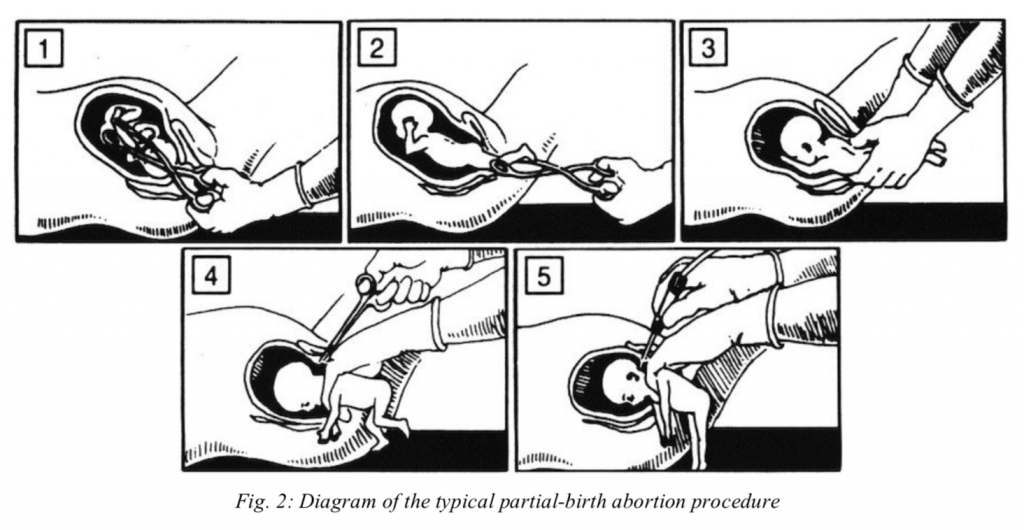
The above graphic was used by The Esperansa Project in its testimony to the Legislature during the public hearing for the bill. What the graphic doesn't show is the child's shock when the physician stabs the child in the back of the skull, then tears a hole in the child's skull large enough to insert a vacuum tube to suck the child's brains out. 

Tuesday, February 21, 2023

MY AMICUS BRIEF - CONTINUED

The Supreme Court will consider two questions set forth by the governor for declaratory judgement, the second of which is the following:

To the extent P.L. 20-134 is not void or otherwise unenforceable, has it been repealed by implication through subsequent changes in Guam law? - See Supreme Court Order

The answer is NO. And here's why.

It appears the question refers to eight abortion-regulating bills enacted into law as follows:

Public Law No.

Date Enacted

Name

Description

Original Bill No.

Sponsors

Date Introduced

P.L 29-115

Nov. 18, 2008

The Partial-Birth Abortion Act of 2008

“THE PARTIAL-BIRTH ABORTION BAN ACT OF 2008. "

Bill No. 374 (EC)

Sens. Eddie Calvo, Frank Blas, Jr., James Espaldon

Oct. 7, 2008

P.L. 31-155

Jan 4, 2012

Parental or Guardian Consent Required for Abortion

Parental or Guardian Consent Required for Abortion

Bill No. 323-31

Sen. Dennis Rodriguez, Jr. 

Oct 5, 2011

P.L. 31-235

Nov. 1, 2012

The Women's Reproductive Health Information Act of 2012

Women’s informed consent required for abortion

Bill No. 54-30 & 52-31

Gov. Eddie Calvo

Jan 25, 2011

P.L. 32-090

Nov. 27, 2013

Infant Child’s Right to Life Act

AN ACT RELATIVE TO PROTECTING INFANTS WHO ARE BORN ALIVE AS A RESULT OF AN ABORTION

Bill No. 195-32

Sen. Frank Aguon, Jr. 

Sep. 25, 2013

P.L. 32-089

Nov. 27, 2013

See description

Deleted the provision in P.L. 31-235 requiring the printed materials and the checklist certification to undergo the rule making process pursuant to the Administrative Adjudication Law. 

Bill No. 193-32

Sen. Dennis Rodriguez, Jr. 

Sep. 23, 2013

P.L 32-217

Dec. 17, 2014

See description

Requires abortion providers to include gestational age in abortion reports

Bill No. 412-32

Sens. Frank Aguon, Jr. and Dennis Rodriguez, Jr. 

Oct 14, 2014

P.L. 33-132

Mar. 4, 2016

Unborn Victims of Violence Act

Criminalized harming or killing the child in the womb in acts of violence against the mother. 

Bill No. 231-33

Sen. Frank Blas, Jr. 

Jan. 19, 2016

P.L. 33-218


Dec. 15, 2016

See description

Increased the penalties of non-compliance of abortion reporting law and added reporting mechanisms to better insure enforcement. 

Bill No. 168-33 

Sens. Frank Aguon, Jr. and Dennis Rodriguez, Jr. 

Aug. 31, 2015

All of the foregoing legislation included language that continued to permit abortion because they had to. Prior to the Dobbs Decision overturning Roe, banning abortion outright was unconstitutional. 

Thus the foregoing bills were drafted, argued, passed, and signed into law because they only proscribed abortion within the limits of U.S. Supreme Court precedent allowing certain regulations relative to abortion.  

The fact that any of these bills still allowed for abortion generally is a function of what was constitutionally required at the time and they do NOT repeal P.L 20-134 "by implication." 

MY AMICUS BRIEF

By Tim Rohr

The Supreme Court of Guam is asking for our input. That's really cool. I don't know about you but I've never been asked to file an amicus brief before. (See: What is an amicus brief.)

From the Guam Daily Post:

Public Law 20-134, the abortion ban of 1990, is a matter of great public interest as its validity and enforceability are in question and the answer will have an impact on many island residents, according to the Supreme Court of Guam, which has called for stakeholders who may be affected by the issue’s outcome to file briefs with the island’s high court. 

Without reading the law, the whole thing sounded weird. 

I get it that the governor might seek a judgment from the high court, but us Tom, Dick and Harry's getting asked to throw in our two cents to help out Guam's most exclusive club, "the Supremes," as Tall Tales talk show host Bob Klitzkie calls them, just sounded...well weird.

On Monday, Bob got a pretty good start in explaining what is really going on, and perhaps today he'll be able to wrap it up. You can catch the first part of Bob's explanation here - which ran until the half time show, and then here after he comes back to it in the second hour. (Note: Bob finished his analysis on Tuesday here.) 

Meanwhile, for those who want to do their own personal dive into the matter, here is the relevant law:

7 GCA § 4104. I Maga’lahi and I Liheslatura May Request Declaratory Judgment.

I Maga’lahen GuĂĄhan, in writing, or I Liheslaturan GuĂĄhan, by resolution, may request declaratory judgments from the Supreme Court of Guam as to the interpretation of any law, federal or local, lying within the jurisdiction of the courts of Guam to decide, and upon any question affecting the powers and duties of I Maga’lahi and the operation of the Executive Branch, or I Liheslaturan GuĂĄhan, respectively. The declaratory judgments may be issued only where it is a matter of great public interest and the normal process of law would cause undue delay. Such declaratory judgments shall not be available to private parties. The Supreme Court of Guam shall, pursuant to its rules and procedure, permit interested parties to be heard on the questions presented and shall render its written judgment thereon. 

So that last line is where we come in:

The Supreme Court of Guam shall, pursuant to its rules and procedure, permit interested parties to be heard on the questions presented and shall render its written judgment thereon. 

However, the part that caught my attention is this:

The declaratory judgments may be issued only where it is a matter of great public interest and the normal process of law would cause undue delay.

Is this really a matter of "great public interest." 

Per the abortion reports published between 2008 and 2018, the most abortions performed in a single year was 327 in 2008:

Source

According to the 2020 Census, Guam's population is 153,836. With a max of 327 abortions in any one year, that's 0.2% of the population. How does that equate to "a matter of great public interest?" 

It appears the only real interest is from the usual few led by the governor who has always been a radical pro-abort. 

Of course whether or not we are okay with killing innocent, defenseless human beings is always "matter of great public interest," however, the governor and her ilk ignore that reality and label said killing merely "health care." 

If abortion is only "health care," then there are certainly many health care concerns in Guam that are of exponentially much greater "public interest." Isn't there. 

And then there is the matter of whether or not the "normal process of law would cause undue delay." 

The governor today could introduce her own bill to ensure abortion is legal, fast track it through committee via her go-for's in the Legislature, then call the Legislature into special session for a vote. 

The whole matter could be wrapped up in a couple weeks. 

So, at least in my view, this declaratory judgment stuff fails on the essential provisions that permits it. I think I'll put that in my brief. 

NOTE: The ORDER pursuant to the Governor's "filing of a Request for Declaratory Judgment" can be found in full here.